For the past several years, the dominant narrative in AI has centered on large language models: bigger transformers, longer context windows, more parameters, better benchmarks. But a parallel research direction has quietly accumulated billions of dollars in funding and some of the field's most prominent names. World models — AI systems designed to internally represent and simulate the physical world — are now being positioned by several major labs as a necessary next step beyond LLMs, and potentially a critical stepping stone toward artificial general intelligence.
Understanding what world models actually are, how they differ from generative video tools, and where the technology genuinely stands today (as opposed to where marketing claims suggest it stands) matters for anyone making architectural or investment decisions involving robotics, simulation, autonomous systems, or embodied AI.
What Distinguishes a World Model from an LLM or Video Generator
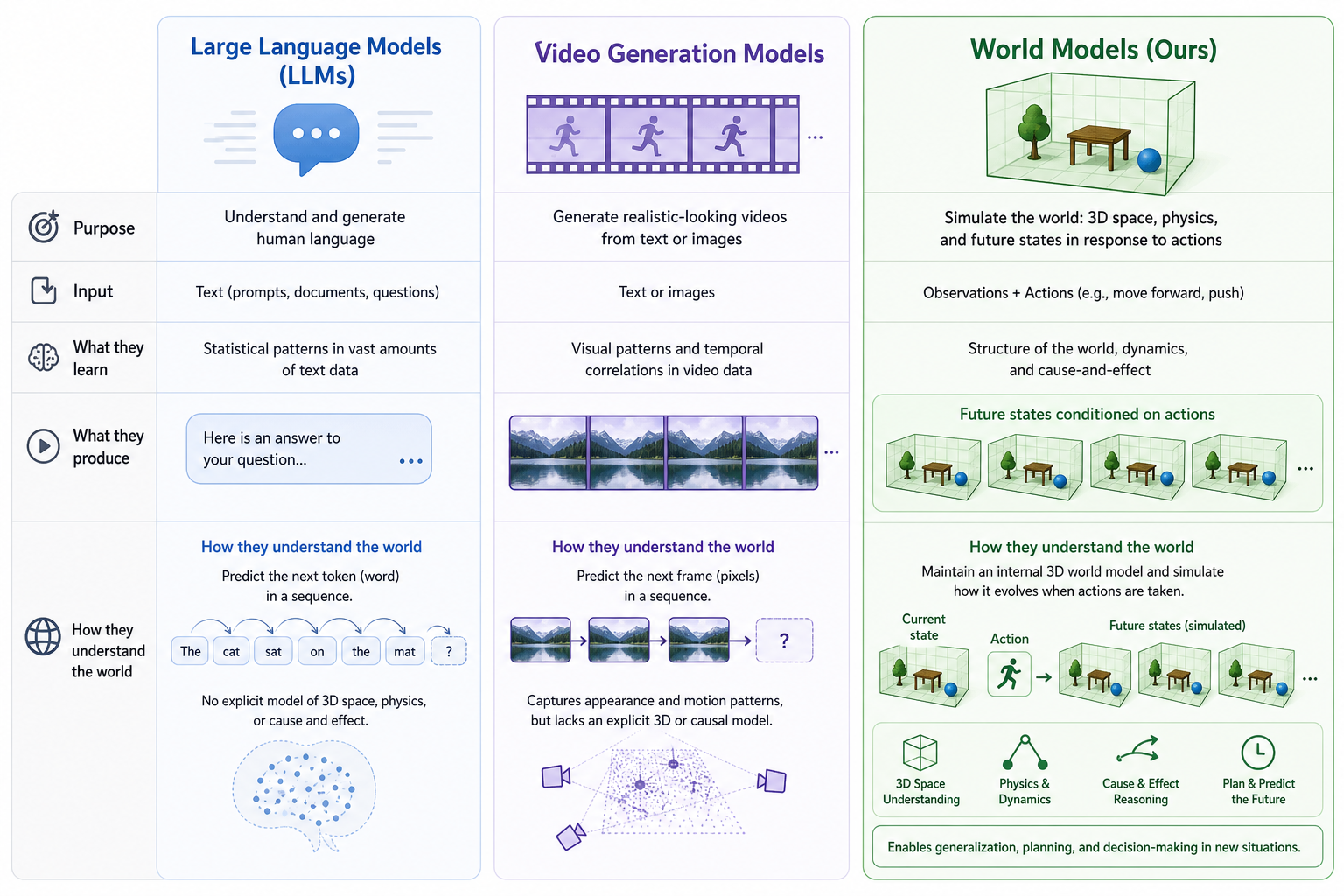
A large language model predicts the next token in a sequence of text. A video generation model produces plausible-looking clips, often without any persistent understanding of the objects, physics, or causal relationships depicted. A world model is architecturally and conceptually different: it builds an internal representation of an environment — including space, time, physics, causality, and object permanence — and uses that representation to simulate how the environment evolves in response to actions.
This distinction produces several capabilities that neither LLMs nor conventional video generators reliably offer:
- Predictive simulation — forecasting future states of an environment rather than generating a single plausible-looking output.
- Action-conditioned response — reacting coherently to real-time interventions, such as a user or agent moving through a generated space.
- Spatial and physical intelligence — understanding 3D geometry, materials, and how objects interact under physical constraints like gravity or collision.
- Long-horizon planning — maintaining logical and physical coherence over extended periods, from minutes to, eventually, hours.
The conceptual roots of this idea predate the current funding boom, tracing back to earlier academic work (notably Jürgen Schmidhuber's research on predictive world models). What has changed is the scale of compute, data, and capital now being directed at turning that research concept into deployable systems.
Google DeepMind's Genie: A General-Purpose World Model
Google DeepMind has been among the most visible proponents of this paradigm. In August 2025, the lab announced Genie 3, described as a general-purpose world model capable of generating an unprecedented diversity of interactive environments. Given a text prompt, Genie 3 generates dynamic worlds that users can navigate in real time at 24 frames per second, at 720p resolution, with consistency maintained for a few minutes.
DeepMind research director Shlomi Fruchter characterized it as "the first real-time interactive general-purpose world model," emphasizing that "it goes beyond narrow world models that existed before. It's not specific to any particular environment." That generality — the ability to simulate a wide range of environments from a single foundation model rather than training narrow, task-specific simulators — is the core claim distinguishing Genie 3 from earlier interactive world-simulation research.
Access to the system has expanded gradually rather than through a full public launch. On January 29, 2026, DeepMind released Project Genie to AI Ultra subscribers, widening availability beyond the initial research preview. Notably, in February 2026, Waymo adopted Genie 3 to build a specialized derivative — the Waymo World Model — for autonomous driving simulation, suggesting real commercial pull from at least one sector where synthetic, physically plausible environments carry direct safety and training value.
It's worth being precise about the current limitations, however. World coherence in Genie 3 holds for only a few minutes before the generated environment begins to drift, and the system remains gated behind subscriber access rather than being generally available. For architects evaluating this technology, the gap between "groundbreaking research preview" and "production-ready simulation infrastructure" is still meaningful.
Fei-Fei Li's World Labs and the Push Toward 3D Generation
Fei-Fei Li, often referred to as the "Godmother of AI" for her foundational work on ImageNet, has taken a related but distinct approach with her startup World Labs. The company raised $230 million to build AI models that understand and interact with the 3D world — what it terms "large world models."
World Labs' first commercial product, Marble, launched with freemium and paid tiers that let users convert text prompts, photos, videos, 3D layouts, or panoramas into editable, downloadable 3D environments. This came a little over a year after World Labs emerged from stealth with its initial funding round, indicating a relatively fast path from research announcement to a shipping product — notable given how much of this category remains pre-commercial.
Investor confidence accelerated further in 2026: World Labs raised a $1 billion Series B in February, led by Autodesk (contributing $200 million) and backed by NVIDIA, AMD, and Andreessen Horowitz. The involvement of Autodesk in particular signals interest from established players in design, engineering, and content-creation tooling, where generative 3D environments could plausibly integrate into existing workflows.
World Labs has also tried to bring some conceptual clarity to a term the company itself acknowledges has become overloaded. In a published essay, the company argued that "world model" now covers three fundamentally different kinds of systems — broadly, models that perceive and generate environments, models that plan within them, and models that simulate their dynamics — and positioned Marble within that taxonomy. This is a useful framework for technical decision-makers trying to compare products that are frequently marketed under the same label despite solving different problems.
Yann LeCun's AMI Labs and the JEPA Architecture
Perhaps the most architecturally distinct approach comes from Yann LeCun, who left Meta to launch Advanced Machine Intelligence (AMI Labs), a startup focused on "building real intelligence into the real world." The venture raised an unusually large $1.03 billion seed round at a reported $3.5 billion pre-money valuation — described as one of the largest seed rounds ever recorded and likely the largest for a European company.
AMI Labs is building on LeCun's Joint Embedding Predictive Architecture (JEPA), a theoretical framework he proposed in 2022. The key technical distinction of JEPA is that it aims to enable AI systems to learn internal models of how the world functions by predicting representations of future states, rather than predicting pixels or words directly. This is a meaningfully different bet than the pixel-level generation approaches used by Genie or Marble: instead of generating a realistic-looking frame of video, a JEPA-based system predicts an abstract embedding of what will happen next, which proponents argue is more computationally efficient and more robust to the kind of irrelevant visual detail that can trip up pixel-prediction models.
AMI Labs CEO Alexandre LeBrun offered an unusually candid assessment of the competitive and hype dynamics in the space: "This category has fewer players than generative AI, but maybe not for long," he said. "My prediction is that 'world models' will be the next buzzword. In six months, every company will call itself a world model to raise funding." That kind of self-aware skepticism from an executive actively raising capital in the category is worth noting — it suggests even insiders recognize the risk of definitional dilution outpacing technical substance.
NVIDIA Cosmos and the Robotics/Physical AI Angle
While DeepMind, World Labs, and AMI Labs have largely framed world models around general intelligence and interactive environment generation, NVIDIA has taken a more applied, infrastructure-oriented approach focused specifically on robotics and autonomous vehicles.
NVIDIA's Cosmos platform comprises generative world foundation models, tokenizers, guardrails, and an accelerated video processing pipeline built to advance physical AI systems. The rationale is straightforward from an engineering standpoint: physical AI models — the kind that control robots or self-driving vehicles — are costly to develop because they require vast amounts of real-world data and testing. Cosmos world foundation models are designed to let developers generate large volumes of photoreal, physics-based synthetic data instead, reducing dependence on expensive real-world data collection.
NVIDIA CEO Jensen Huang has framed this as an imminent inflection point, stating that "the big bang of physical AI is just around the corner thanks to breakthroughs in multimodal reasoning language, vision and world models." Unlike some of the more research-preview-stage offerings elsewhere in the category, Cosmos has seen substantial real-world adoption: the world foundation models have been downloaded over 2 million times, with developers using them to generate diverse training data for robots at scale via text, image, and video prompts. This download figure is one of the more concrete adoption signals in the world model space, distinguishing Cosmos from products still primarily discussed in terms of funding rounds and demo videos.
Comparing the Major Players
| Organization | Product / Architecture | Primary Focus | Funding | Adoption Signal | Key Limitation |
|---|---|---|---|---|---|
| Google DeepMind | Genie 3 | General-purpose interactive world simulation | Internal (Google) | Adopted by Waymo for driving simulation | Coherence holds only a few minutes; gated to subscribers |
| Fei-Fei Li's World Labs | Marble | 3D content generation from text/photo/video/panorama | $230M seed + $1B Series B (2026) | Shipping freemium/paid product; Autodesk-backed | Category still maturing; taxonomy itself contested |
| Yann LeCun's AMI Labs | JEPA-based architecture | Representation-level prediction of future states | $1.03B seed at $3.5B pre-money | Earliest-stage commercially | No shipping product yet |
| NVIDIA | Cosmos platform | Synthetic training data for robotics/autonomous vehicles | Internal (NVIDIA) | 2M+ downloads of foundation models | Narrower scope than "general" world models |
Where the Field Broadly Agrees
Across DeepMind, World Labs, AMI Labs, and NVIDIA, there is clear convergence on a few points.
First, there's broad agreement that text-based LLMs, on their own, cannot achieve the kind of physical and causal reasoning required for robotics, autonomous vehicles, and further progress toward AGI — world models are positioned as filling that gap.
Second, latent-space or representation-level prediction (as in LeCun's JEPA) is widely cited as a promising technical direction, distinct from the pixel-level generation approaches used by systems like Genie and Marble, even though both camps fall under the same broad umbrella term.
Third, 2026 has seen a genuine and significant influx of capital into this category, with billion-dollar-plus rounds for both World Labs and AMI Labs signaling strong investor conviction in the space's long-term importance — even as commercial products remain, in most cases, nascent.
The consensus, in short, is directional: most serious players agree world models matter and are underinvested relative to LLMs. There is far less consensus on which architectural approach — pixel-level generative simulation, latent-space prediction, or task-specific synthetic data generation — will prove most valuable in production settings.
Where the Field Diverges
For technical leaders evaluating whether and how to invest in this category, the areas of disagreement and unresolved tension are arguably more important than the areas of consensus.
Commercial timelines remain genuinely uncertain. Analysts have noted that the claim that world models represent a categorical solution to LLM failure modes is contested. World models have their own generalization challenges, particularly when confronted with novel environments outside their training distribution. The gap between technical promise and commercial application is precisely where many well-funded research labs have historically struggled, and there's no strong evidence yet that world models will avoid that pattern.
The term itself lacks a settled definition. World Labs' own acknowledgment that "world model" spans three fundamentally different kinds of systems is telling. When a category leader feels compelled to publish a taxonomy distinguishing its own product from others using the same label, that's a signal the field hasn't converged on clear definitions — even as investment accelerates. This creates real due-diligence risk: two products both marketed as "world models" may address entirely different problems, use incompatible architectures, and target different deployment contexts (interactive entertainment versus robotics training data versus autonomous vehicle simulation).
Technical limitations are real and currently binding. Genie 3, despite being described internally as a breakthrough, maintains world coherence for only a few minutes before drift sets in, and remains gated behind limited subscriber access rather than being generally available. This is not a criticism of the research — a few minutes of coherent, action-conditioned, real-time environment generation is a genuine technical achievement — but it does mean organizations evaluating these tools for production use cases should treat current capabilities as early-stage rather than deployment-ready.
Practical Takeaways for Technical Teams
For architects and decision-makers tracking this space, a few practical distinctions are worth keeping in mind.
If your interest is synthetic data generation for robotics or autonomous vehicle training, NVIDIA's Cosmos platform currently shows the most concrete adoption evidence, with millions of downloads and a clear, narrow value proposition tied to reducing real-world data collection costs.
If your interest is interactive 3D content generation for design, gaming, or spatial content workflows, World Labs' Marble is furthest along toward a shipping commercial product, backed notably by Autodesk's strategic investment.
If you're tracking foundational research that might reshape how world models are built architecturally, LeCun's JEPA-based approach at AMI Labs represents a genuinely different technical bet worth monitoring, even though it's earliest in its commercial lifecycle.
And if you want to understand where the frontier of general-purpose, real-time interactive simulation currently sits, DeepMind's Genie 3 is the most technically ambitious public demonstration, tempered by its current access restrictions and multi-minute coherence limits.
Conclusion
World models have moved, within roughly a year, from an academic concept with roots in decades-old research to one of the most heavily capitalized categories in AI, drawing serious commitments from Google DeepMind, Fei-Fei Li's World Labs, Yann LeCun's AMI Labs, and NVIDIA. The underlying thesis — that physical, spatial, and causal understanding requires a fundamentally different architecture than next-token prediction — has broad support among some of the field's most credible researchers.
But the category is also, by its own practitioners' admission, at risk of becoming diluted by hype. AMI Labs' own CEO predicted that "world model" will become the next AI buzzword, applied loosely by companies seeking funding rather than describing a coherent technical approach. For technical decision-makers, the prudent path is to evaluate specific products against specific use cases — synthetic training data, 3D content generation, interactive simulation, or foundational research — rather than treating "world model" as a single, well-defined category with uniform maturity across vendors.