For most of its history, quantum error correction (QEC) lived in the realm of theoretical promise and small-scale laboratory demonstrations. Physical qubits are noisy, fragile, and prone to decoherence, and the entire premise of scalable quantum computing has always rested on the assumption that error correction could eventually tame that noise. In 2026, that assumption stopped being an open question and started becoming an engineering roadmap.
Across multiple hardware platforms — superconducting, neutral atom, and trapped ion — research teams have demonstrated logical qubits that outperform their underlying physical components, decoders that operate in real time, and error-correction schemes that measurably improve the accuracy of actual computations, not just idle memory.
This shift matters enormously for technology professionals tracking the trajectory of quantum computing. The difference between a physics experiment and an engineering discipline is repeatability, scalability, and predictable improvement curves. 2026 is the year multiple independent teams provided evidence that QEC has entered that second phase.
Why Error Correction Is the Central Bottleneck
Quantum computers derive their power from superposition and entanglement, but these same properties make qubits exceptionally sensitive to environmental noise. A single stray photon, a thermal fluctuation, or an imperfect control pulse can flip a qubit's state or introduce phase errors that corrupt a computation.
Unlike classical bits, qubits cannot simply be copied to create redundancy — the no-cloning theorem forbids it — so quantum error correction relies on more sophisticated strategies: encoding a single "logical" qubit across many physical qubits in a way that allows errors to be detected and corrected without directly measuring (and thus destroying) the quantum information itself.
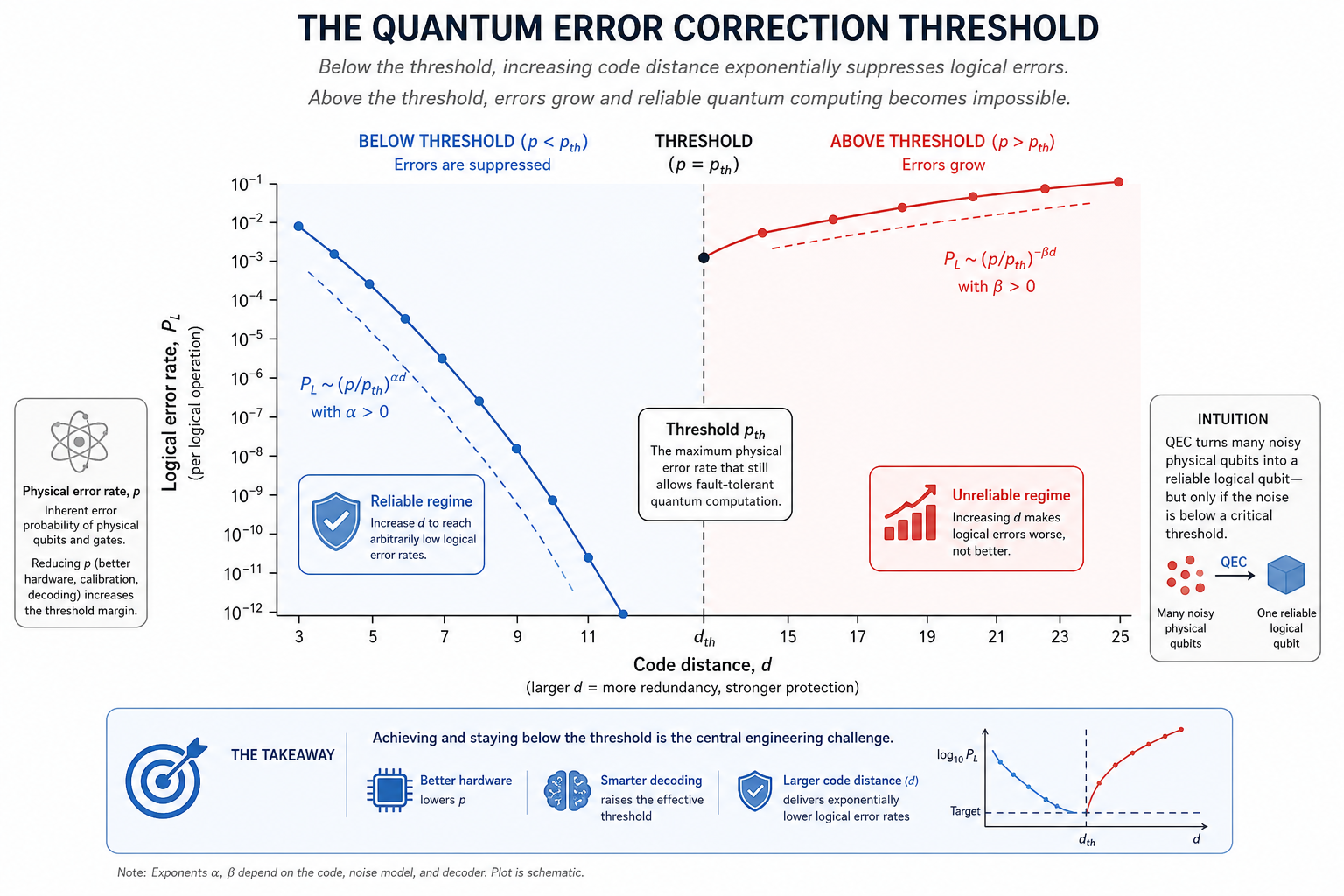
The central challenge has always been the error correction threshold: a mathematical condition stating that if the physical error rate per operation is below a certain value, increasing the size of the error-correcting code will suppress the logical error rate exponentially. Above that threshold, adding more physical qubits only adds more noise.
For nearly three decades, hardware performance hovered frustratingly close to this line. In 2026, several platforms have not only crossed it — they have demonstrated the exponential suppression the theory predicted.
Google's Below-Threshold Result: The Foundational Milestone
The result most frequently cited as the foundation for this year's momentum comes from Google Quantum AI's Willow chip, published in Nature. The team demonstrated two below-threshold surface code memories: a distance-7 code and a distance-5 code, the latter integrated with a real-time decoder capable of processing correction data as fast as errors occur.
The standout figure is the suppression factor: increasing the code distance by 2 suppressed the logical error rate by a factor of Λ = 2.14 ± 0.02. In practical terms, this means that scaling up the error-correcting code produces predictable, compounding improvements in logical qubit stability — exactly the behavior theorists have sought since the threshold theorem was first proposed. The largest configuration tested, a 101-qubit distance-7 code, achieved a logical error rate of 0.143% ± 0.003% per cycle.
Perhaps more consequential than the suppression factor itself is the claim of "beyond breakeven" performance: the logical qubit's memory lifetime exceeded that of the best individual physical qubit in the system by a factor of 2.4 ± 0.3. This is a critical distinction. Many earlier QEC demonstrations showed error suppression in principle but still underperformed a single well-isolated physical qubit in practice.
Google's result shows that the overhead of encoding — extra qubits, extra control complexity, extra decoding latency — is now decisively paying for itself. Physicist John Preskill, who coined the term "quantum supremacy," described the result as "a notable milestone," a characteristically measured endorsement from one of the field's most cautious voices.
The Logical Qubit Leaderboard: Count Versus Efficiency
With the threshold question largely settled, the competitive conversation in 2026 has shifted to two related but distinct metrics: how many logical qubits a system can support, and how efficiently it converts physical qubits into logical ones. These numbers matter because the physical-to-logical qubit ratio determines how a quantum computer's hardware requirements will scale as applications demand more logical qubits.
QuEra, using neutral-atom hardware, currently holds the raw count lead. In a January 2026 Nature publication, the company demonstrated 96 verified logical qubits built from 448 neutral atoms, using high-rate [[16,6,4]] quantum low-density parity-check (LDPC) codes at a 4.7-to-1 physical-to-logical ratio. This is a substantial efficiency gain over earlier surface-code approaches, which historically required ratios in the range of tens or even a hundred physical qubits per logical qubit.
Quantinuum, working with trapped-ion technology, has pushed efficiency even further. On its 98-qubit Helios processor, the company demonstrated computations using up to 94 error-detected logical qubits and 48 fully error-corrected logical qubits — a 2-to-1 physical-to-logical ratio that no other hardware modality has yet matched. According to Quantinuum's own SEC filings, this represents the first commercial demonstration of a 2:1 ratio, a striking contrast to the overheads of up to 100:1 quoted in earlier surface-code studies, including Google's 2025 Nature work. Helios also reported 99.92 percent two-qubit gate fidelity, among the highest fidelities publicly reported across any platform.
Atom Computing and Microsoft, working jointly, demonstrated 24 logical qubits in late 2024 using Bacon-Shor codes on Atom's Phoenix neutral-atom system, at a 49-to-1 ratio — a useful data point illustrating how quickly encoding efficiency has improved industry-wide in roughly eighteen months.
The table below summarizes where each major platform stands as of 2026:
| Platform / Company | Hardware Type | Logical Qubits Demonstrated | Physical-to-Logical Ratio | Notable Detail |
|---|---|---|---|---|
| Google Quantum AI | Superconducting | Below-threshold memory (distance-7 code) | N/A (memory demo, not logical qubit count) | First validated exponential error suppression; 2.4x beyond breakeven |
| QuEra | Neutral atom | 96 verified logical qubits | 4.7:1 | Highest raw logical qubit count |
| Quantinuum | Trapped ion | 94 error-detected / 48 fully error-corrected | 2:1 | Best efficiency ratio industry-wide; 99.92% two-qubit fidelity |
| Atom Computing + Microsoft | Neutral atom | 24 logical qubits (late 2024) | 49:1 | Baseline showing rapid efficiency gains since 2024 |
Looking ahead, roadmap targets for 2026 and beyond give a sense of the field's expected trajectory. Atom Computing and Microsoft's jointly developed "Magne" system is targeting 50 logical qubits by late 2026. Quantinuum and Pasqal are both eyeing the 100+ logical qubit range.
Quantinuum's own public roadmap is particularly detailed: its "Sol" system, expected in 2027, targets approximately 100 logical qubits with fidelity approaching 99.999% ("five nines"), while "Apollo," targeted for 2029, aims to deliver hundreds of logical qubits at fidelities up to 99.99999999% ("ten nines"). These fidelity targets are not incremental — each additional "nine" represents an order-of-magnitude reduction in error rate, and reaching ten nines would put logical qubit reliability in a range suitable for long, complex algorithms rather than short demonstration circuits.
Beyond Memory: Error Correction During Actual Computation
A subtler but arguably more important development came in June 2026, when Microsoft Quantum and Quantinuum published a joint Nature study that moved past static logical-memory benchmarks and into active computation. Most prior QEC milestones, including Google's below-threshold result, primarily measured how long a logical qubit could preserve information while sitting idle. The Microsoft-Quantinuum study instead measured how error correction performs when a quantum processor is actively executing a circuit — arguably a closer proxy for real-world use.
Using two error-correction schemes known as the carbon code and the tesseract code, the researchers demonstrated repeated, mid-computation error correction across experiments involving up to 12 logical qubits. The results showed error reductions ranging from 11-fold to 800-fold compared to running equivalent calculations directly on physical qubits, depending on the specific circuit and code used.
That wide range is itself informative: it suggests that the benefit of error correction is highly dependent on circuit structure and code choice, and that near-term advantage will likely come from selectively applying fault-tolerant techniques where they matter most, rather than uniformly encoding every computation.
The researchers were candid about the limitations: while current quantum processors can already benefit from fault-tolerant techniques, further advances in hardware, real-time decoding, and scalable error-correction methods are still required before large-scale, practically useful quantum computers become viable. This is a meaningfully more grounded framing than headline-grabbing "breakthrough" language — it positions 2026 as a year of demonstrated benefit, not final arrival.
IBM's Architectural Bet: Connectivity and Real-Time Decoding
IBM's 2026 roadmap takes a distinctly architectural approach to the same underlying problem. Rather than emphasizing logical qubit counts, IBM has focused its public roadmap on two enabling technologies: real-time decoders and improved qubit connectivity. In 2026, the company is prototyping its error-correction decoder, a system designed to enable real-time error correction — a capability considered essential for any large-scale, fault-tolerant quantum computer, since classical decoding that lags behind the physical error rate effectively negates the benefit of encoding.
Supporting this effort is IBM's Loon chip, which debuted in 2025 with a new architecture built around "c-couplers" — components that link qubits beyond their nearest neighbors, enabling up to six degrees of connectivity per qubit. Higher connectivity is directly relevant to error correction because many efficient quantum LDPC codes, including the high-rate codes used by QuEra, require qubits to interact with partners that are not physically adjacent on a simple grid.
IBM states that this architectural advancement strengthens its confidence in achieving large-scale, fault-tolerant quantum computing by 2029 — a timeline that aligns closely with Quantinuum's own roadmap milestones.
Neutral Atoms and the Theoretical Frontier
While much of 2026's news has centered on hardware demonstrations, there has also been significant theoretical progress underpinning future gains. QuEra highlighted a 2026 construction by researcher Kasai that introduced affine permutation matrices — mathematical maps of the form x → ax + b (mod P) — as a replacement for the circulant permutation matrices used in earlier quantum LDPC code constructions.
This may sound like an abstract mathematical refinement, but its practical implications are substantial: building on this construction, QuEra's simulations reported per-logical-per-round error rates approaching the so-called Teraquop regime — roughly 1.3×10⁻¹³ under a realistic circuit-level noise model. The Teraquop threshold refers to the point at which a quantum computer could reliably execute on the order of a trillion quantum operations, a scale generally considered necessary for commercially significant applications like large-scale chemistry simulation or cryptographically relevant factoring.
QuEra also noted the broader momentum across the research community: the past two years have produced a steady stream of advances spanning code construction, logical memory simulation, logical gate operations, and decoding algorithms — a cumulative body of work that is pushing fault-tolerant quantum computing closer to practical reality than the milestone announcements alone might suggest.
Hardware Fidelity: The Underlying Enabler
None of these architectural and theoretical advances would matter without steady improvement in raw physical qubit fidelity, since QEC codes only function below their error threshold. Across the industry in 2026, two-qubit gate fidelities are reported at roughly 99.99% on trapped-ion platforms such as IonQ and Oxford Ionics, 99.5–99.9% on superconducting platforms including IBM's Heron R2 and Quantinuum's Helios, and around 99.5% on neutral-atom systems from Atom Computing and QuEra.
These figures represent the physical substrate on which all logical qubit demonstrations depend, and continued incremental gains here directly translate into lower overhead for error-correcting codes.
A Global Effort: Contributions Beyond the Usual Players
Progress in 2026 has not been confined to the US-based companies most frequently covered in Western tech media. Chinese firm SpinQ, working in collaboration with the Hong Kong University of Science and Technology, secured nearly 1 billion RMB in Series C funding and reported achieving a 4.35% fault-tolerance threshold using newly developed quantum error correction techniques aimed at industrial-scale quantum computing.
The team's research on efficient quantum decoding algorithms was accepted for presentation at QEC 2026, widely regarded as the leading academic conference dedicated specifically to quantum error correction — a sign that the competitive and collaborative landscape for QEC research remains genuinely global.
Where the Field Agrees — and Where It Doesn't
Across Google, QuEra, Quantinuum, IBM, Microsoft, and SpinQ, there is broad agreement on one central point: 2026 represents a genuine transition from theoretical and small-scale laboratory QEC toward engineering-scale demonstration. Neutral-atom platforms, led by QuEra, currently lead on raw logical qubit counts, while trapped-ion platforms, led by Quantinuum, lead on encoding efficiency with the industry's first 2-to-1 physical-to-logical ratio. Superconducting platforms, led by Google and IBM, have provided the clearest theoretical validation of below-threshold behavior and are investing heavily in the real-time decoding infrastructure that any platform will eventually need.
Where the field diverges is on timeline. Industry roadmaps from IBM and Quantinuum converge on full fault tolerance arriving around 2029, a specific and relatively near-term target. Broader industry commentary is more cautious. Nvidia CEO Jensen Huang, for instance, offered a conservative estimate of 15 to 30 years for "very useful" quantum applications before softening that position somewhat in subsequent remarks, while Microsoft co-founder Bill Gates has offered a considerably more optimistic forecast of three to five years.
This spread illustrates an important reality for technical decision makers: hardware and algorithmic progress in QEC is now well-documented and verifiable, but translating logical qubit milestones into commercially transformative applications remains a separate, less predictable challenge.
What This Means for Technical Decision Makers
For architects and technology leaders evaluating quantum computing investments, the practical takeaway from 2026's progress is that the fundamental physics risk around error correction has meaningfully decreased. The threshold theorem has been experimentally validated across multiple hardware modalities, encoding efficiency is improving at a pace that suggests the historically cited "100 physical qubits per logical qubit" overhead is not a fixed law of nature but an artifact of early code choices, and real-time decoding — long considered one of the hardest unsolved engineering problems in the field — is now in active prototyping at multiple companies.
What remains uncertain is less about whether fault-tolerant quantum computing will arrive, and more about exactly when, on which hardware platform, and at what cost structure. Organizations planning multi-year quantum strategies should treat 2029 as a plausible target for early fault-tolerant systems based on current public roadmaps, while remaining aware that historical quantum computing timelines have frequently slipped.
The more actionable signal from 2026 is that error correction has stopped being the field's central unsolved physics problem and has become, as multiple sources now describe it, an engineering discipline with measurable, compounding progress.