Quantum computing has spent decades as a promising but largely theoretical field, punctuated by incremental hardware milestones and cautious optimism. That narrative is changing. Multiple industry analyses, government programs, and peer-reviewed publications now point to 2026 as an inflection point — the moment quantum computing begins moving out of research laboratories and into early-stage commercial deployment. The United Nations has underscored this shift by designating 2026 the International Year of Quantum Science and Technology, explicitly framing it as the period when quantum computing transitions from theory toward practical application.
For technology leaders, architects, and developers, understanding this transition matters now, not in some distant future. Decisions about cryptographic infrastructure, R&D partnerships, and long-term computing strategy are already being shaped by developments happening this year. Below is a synthesis of the key trends defining quantum computing in 2026.
Hybrid Quantum-Classical Computing Becomes the Dominant Model
Despite years of speculation about quantum computers eventually replacing classical infrastructure, the near-term consensus across industry sources is more measured: hybrid architectures, not standalone quantum systems, are what businesses are actually building.
In this model, quantum processors are reserved for the narrow class of problems where they offer genuine advantage — difficult optimization tasks and certain simulations — while classical high-performance computing and AI systems continue to handle everything else. As industry analysis from Forbes contributor Bernard Marr puts it, businesses in 2026 are building hybrid workflows where quantum processors tackle computation-heavy problems while classical supercomputers or AI manage routine workloads. This reflects a practical reality: quantum computers specialize in particular calculation-heavy problem-solving tasks, and for most everyday computing needs, classical systems remain not just adequate but preferable for the foreseeable future.
This hybrid framing matters for technical decision-makers because it reframes the adoption question. Organizations don't need to choose between quantum and classical infrastructure — they need to identify which specific workloads within their existing pipelines could benefit from quantum acceleration, and build integration points accordingly.
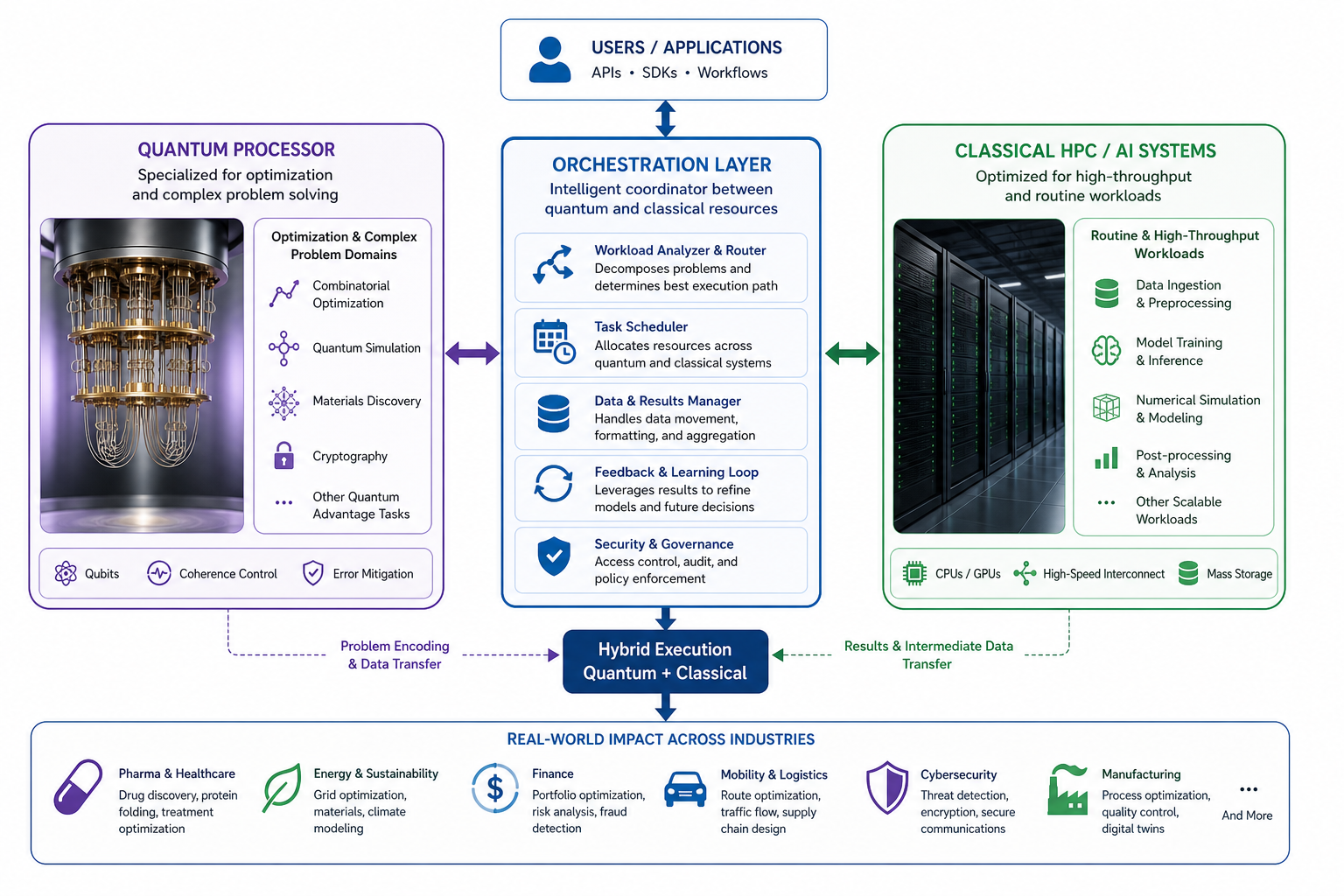
Early adopter industries are consistently identified across sources: finance, pharmaceuticals, and logistics are leading quantum computing adoption through pilot programs. These sectors share a common trait — they all have high-value problems (portfolio optimization, molecular simulation, route and supply-chain optimization) that scale poorly on classical hardware but map naturally onto quantum algorithms.
Error Correction: The Field's Central Technical Story
If there is one development that defines quantum computing's 2026 narrative, it's progress on quantum error correction (QEC) and the emergence of verified logical qubits — error-corrected units of quantum information built from multiple physical qubits.
For years, a foundational concern loomed over the field: as quantum systems scaled up, would error rates increase, making larger systems less reliable rather than more capable? The most technically significant milestone reported in 2025-2026 answers that question decisively. Researchers have demonstrated that logical error rates decrease exponentially as quantum systems grow larger, not increase. This finding is being described as a fundamental shift — one that moves quantum computing from a physics research problem into an engineering discipline. In plain terms: in 2026, quantum computing stopped being primarily a physics research project and started becoming a scalable engineering discipline with real commercial implications.
This shift is not abstract. It's backed by concrete, verifiable milestones from multiple hardware vendors:
| Vendor | Milestone | Physical Qubits | Logical Qubits | Key Detail |
|---|---|---|---|---|
| QuEra | [[16,6,4]] high-rate error-correcting code | 448 | 96 | Published in Nature, January 2026 |
| Quantinuum | Helios system (color codes) | 98 | 48 | Industry-leading 2:1 encoding ratio; described as most accurate quantum computer in the world |
| IBM | Quantum Loon processor | — | — | Real-time error decoding in under 480 nanoseconds using quantum LDPC codes; 10x speedup over prior methods |
The pace of underlying research reflects this momentum: peer-reviewed papers on quantum error correction grew from 36 in 2024 to over 120 in 2025 — a tripling of research output in a single year.
According to industry tracking, five organizations now have verified logical qubit demonstrations on record. The competitive and financial dimensions of this progress are also becoming visible: the first neutral-atom quantum company, Infleqtion, went public on the NYSE in February 2026, and IonQ became the first quantum computing company to exceed $100 million in GAAP annual revenue.
For architects and technical strategists, the significance of the QEC story is this: encoding ratios, logical qubit counts, and decoding speeds are becoming meaningful benchmarks for evaluating vendor roadmaps — much the way clock speed and core counts once served as shorthand metrics in classical computing.
Real-World Scientific and Industrial Applications Are Emerging
While much of quantum computing's value remains prospective, 2026 has produced tangible, published examples of quantum hardware being applied to problems with direct industrial relevance — particularly in drug discovery and materials science.
IBM's collaborations illustrate this well. Working with the Cleveland Clinic, IBM demonstrated a 303-atom protein simulation — described as the first quantum simulation of a protein's full electronic structure — using its Heron r2 hardware. This is being characterized as a milestone for drug discovery, since accurately modeling protein electronic structure is a computationally intractable problem for classical computers at meaningful scale.
IBM has also reported verifying the structure of the half-Möbius C13Cl2 molecule, published in Science in collaboration with the Universities of Manchester and Oxford, and simulating iron-sulfur clusters using Heron hardware paired with RIKEN's Fugaku supercomputer across 152,064 nodes — a concrete example of the hybrid quantum-classical model in action at a national-lab scale.
These examples matter because they move the conversation beyond theoretical algorithmic speedups and into peer-reviewed, reproducible scientific results with practical downstream applications in pharmaceuticals and chemistry.
Funding, IPOs, and a Fragmented but Growing Market
Government and private capital are flowing into quantum computing at levels that reflect genuine strategic prioritization, not just speculative interest.
On the public sector side, the U.S. Department of Commerce signed nine letters of intent in May 2026 to provide $2.01 billion in federal incentives under the CHIPS and Science Act to support quantum computing companies. DARPA has taken a longer-view approach, committing to a formal program to validate utility-scale quantum computing by 2033. Its Quantum Benchmarking Initiative has advanced 11 companies to Stage B, tasking them with demonstrating utility-scale quantum computing within that timeframe. The roster is notably broad, spanning Atom Computing, Diraq, IBM, IonQ, Nord Quantique, Photonic Inc., Quantinuum, Quantum Motion, QuEra, SQC, and Xanadu — an indication that no single hardware modality (superconducting, trapped-ion, neutral-atom, photonic, or silicon spin) has yet been declared the clear winner.
Capital markets activity is accelerating in parallel. A potential Quantinuum IPO is being described as a landmark event — one that would represent the largest capital market event in quantum computing history, offering both a liquidity event for early investors and a public benchmark for how markets value the sector. Separately, JPMorgan Chase announced a $10 billion strategic technology initiative in 2025, with portions tied to quantum-adjacent computing infrastructure — a signal that major financial institutions are treating quantum readiness as part of broader technology strategy rather than a niche R&D bet.
Market size projections, however, vary dramatically across research firms, and technical decision-makers should treat any single figure with appropriate skepticism:
| Research Firm | 2025 Estimate | 2026 Estimate | Long-Term Projection | CAGR |
|---|---|---|---|---|
| Grand View Research | $1.6B | $1.9B | $8.0B by 2033 | 22.3% |
| Fortune Business Insights | — | $1.82B | $17.89B by 2034 | 33.0% |
| The Business Research Company | $3.62B | $5.09B | — | 40.5% |
| MarketsandMarkets | $3.52B | — | $20.20B by 2030 | 41.8% |
This roughly $1.4–3.6 billion range in baseline 2025/2026 estimates, paired with CAGR projections spanning 22% to nearly 42%, reflects genuine methodological disagreement — primarily around whether "quantum computing revenue" includes only hardware, or also software and services layered on top. What all four firms agree on, despite this variance, is a strong double-digit-to-high-double-digit growth trajectory over the next several years. For architects evaluating vendor stability or budget planning, the practical takeaway is to focus less on any single market-size figure and more on the consistent directional signal: sustained, accelerating investment.
Post-Quantum Cryptography: The Most Time-Sensitive Trend
Among all the developments shaping quantum computing in 2026, post-quantum cryptography (PQC) stands out as the most immediately consequential for technical teams — because it requires action now, independent of when large-scale fault-tolerant quantum computers actually arrive.
The standards landscape has matured significantly. FIPS 203, FIPS 204, and FIPS 205 — specifying algorithms derived from CRYSTALS-Kyber, CRYSTALS-Dilithium, and SPHINCS+ respectively — were published by NIST on August 13, 2024. These represent the first finalized federal standards for post-quantum key encapsulation and digital signatures. The standardization process has continued to evolve: HQC (Hamming Quasi-Cyclic) was selected for standardization on March 11, 2025, adding a structurally distinct code-based algorithm to the portfolio — an important hedge, since diversifying the mathematical foundations of PQC standards reduces the risk that a single future cryptanalytic breakthrough could compromise multiple algorithms at once.
The urgency behind PQC adoption stems from a well-understood but often underappreciated threat model: "harvest now, decrypt later." Adversaries capable of intercepting and storing encrypted traffic today can decrypt it retroactively once sufficiently powerful quantum computers exist, capable of breaking RSA and elliptic-curve cryptography via Shor's algorithm. For any data with a long confidentiality shelf life — health records, government communications, intellectual property, financial records — the migration timeline to quantum-resistant algorithms needs to be measured against how long that data must remain confidential, not against optimistic estimates of when cryptographically relevant quantum computers will exist.
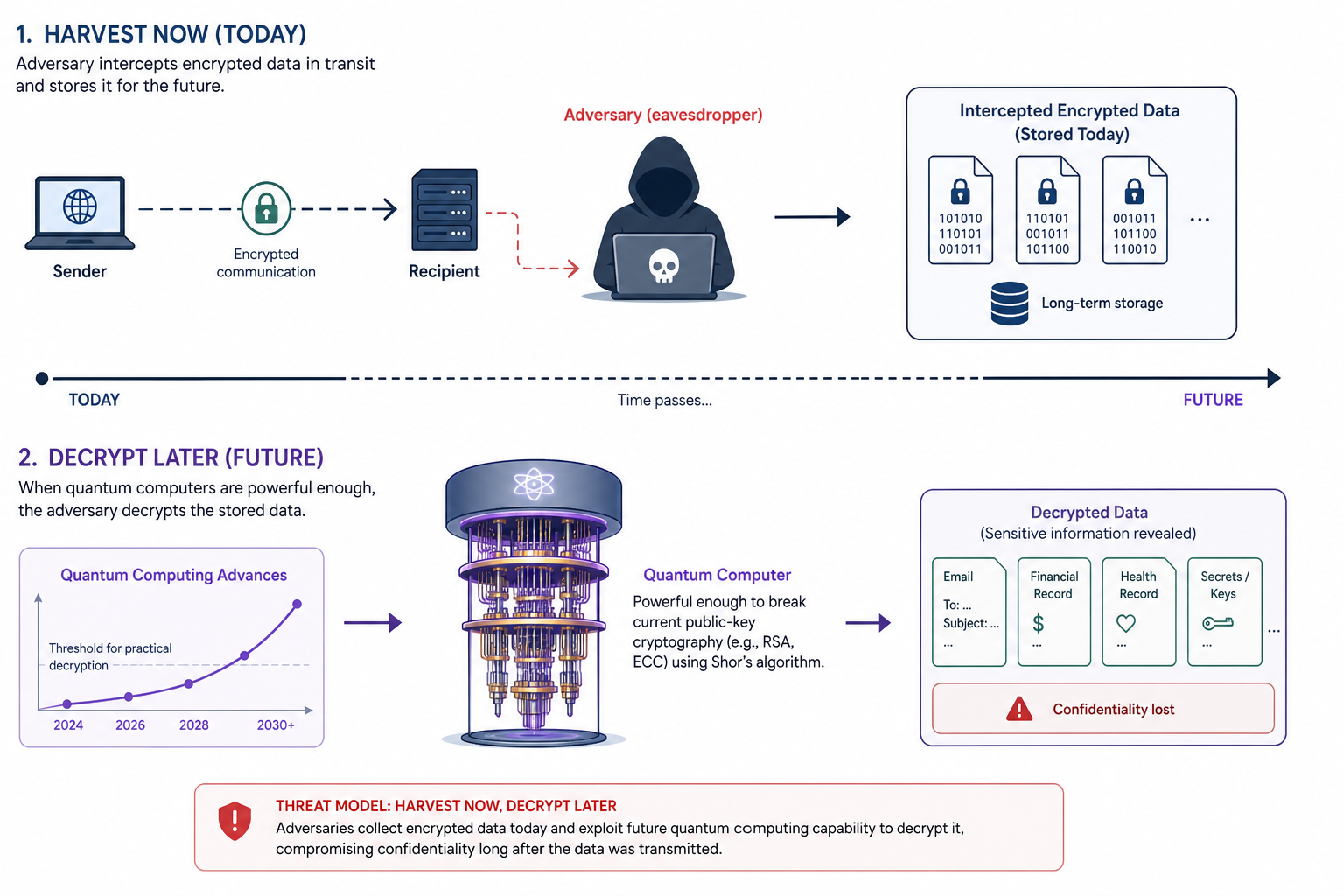
Real-world adoption data reflects growing recognition of this urgency, with major infrastructure providers reporting accelerating deployment of post-quantum key exchange mechanisms across internet traffic. For technical decision-makers, this translates into concrete near-term priorities: inventorying cryptographic dependencies across systems, prioritizing crypto-agility in architecture decisions, and beginning migration planning toward NIST-standardized PQC algorithms rather than waiting for a forcing event.
What This Means for Technical Decision-Makers
Taken together, these trends paint a picture of a field in genuine transition, though not one where speculative hype should be mistaken for present-day universal utility. Three practical implications stand out for architects and technology leaders:
First, quantum computing's near-term value proposition is domain-specific, not general-purpose. Organizations in finance, pharmaceuticals, logistics, and materials science have the clearest paths to early value through hybrid quantum-classical pilot programs, particularly for optimization and simulation problems that are intractable classically.
Second, the shift from physics experiment to engineering discipline — driven by demonstrated logical qubit scaling and error correction progress — means that hardware roadmaps are becoming more predictable and benchmarkable. Tracking metrics like logical qubit counts, encoding ratios, and error-decoding latency provides a more grounded basis for vendor evaluation than headline physical qubit counts alone.
Third, and most urgently, post-quantum cryptography migration is not contingent on quantum computing's broader commercial timeline. The standards exist today, the harvest-now-decrypt-later threat is active today, and the technical work of achieving crypto-agility should be treated as a current infrastructure priority rather than a future contingency.
2026 will not be the year quantum computers become mainstream general-purpose machines. But it is shaping up to be the year the field's trajectory — from error correction breakthroughs to cryptographic standards to real capital markets activity — became concrete enough for technical organizations to plan around with genuine confidence.