For technology leaders trying to plan five- and ten-year infrastructure strategies, few questions generate more noise than "what will quantum computing do to AI?" Press releases promise revolutions. Skeptics call it hype. The reality, grounded in where the technology actually stands in 2026, is more nuanced—and more useful for planning purposes—than either extreme suggests.
The short answer: quantum computing and AI are developing as complementary technologies, not competitors. Quantum hardware is unlikely to replace neural networks, GPUs, or the deep learning stack that dominates AI today. Instead, it is being explored as a specialized accelerator for specific bottlenecks—optimization, sampling, and certain simulation tasks—that feed into broader AI pipelines. And critically, the traffic right now runs more in the opposite direction: AI is what's currently making quantum computers usable, not the other way around.
From Research Curiosity to Adoption Phase
After years confined largely to academic and corporate research labs, quantum computing has entered what analysts describe as an early adoption phase. Four trends are shaping this shift in 2026: the rise of hybrid quantum-classical computing architectures, the emergence of first industrial use cases, continued progress on error correction, and growing attention to quantum's implications for cybersecurity.
This is a meaningful shift in framing. Quantum computing is no longer being discussed purely as a distant theoretical possibility—it's being positioned as a strategic lever for AI, digital security, and economic competitiveness.
But "adoption phase" does not mean "deployed at scale." It means organizations are beginning to build pilot programs, hybrid architectures, and internal expertise ahead of a hardware maturity curve that most credible sources still place several years out.
AI Is Currently Helping Quantum, Not the Reverse
One of the most important—and least publicized—facts about the quantum-AI relationship today is that AI is doing much of the heavy lifting to make quantum hardware viable in the first place. Quantum computers are notoriously difficult to build and operate: qubits are fragile, prone to decoherence, and require constant calibration. AI techniques are being used to support experiment design, hardware calibration, error mitigation, and system optimization on quantum devices. Without this AI-driven support, scaling quantum systems would be significantly slower than it already is.
This matters for how technical decision-makers should think about the relationship. It's not quantum computing arriving to supercharge AI overnight. It's a slower, more symbiotic bootstrapping process, where classical machine learning is currently the more mature partner enabling quantum hardware to become practical—setting the stage for quantum to eventually return the favor in narrower ways.
Where Quantum Could Actually Help AI Workloads
It's worth being precise about what quantum computing is—and isn't—expected to change in AI. Quantum computing is being explored to address specific computational bottlenecks inside AI workflows, such as optimization, sampling, and reinforcement learning at scale, rather than to replace neural networks or existing AI systems outright.
The architecture most frequently described by industry analysts looks less like a wholesale replacement of today's AI infrastructure and more like an extension of it: quantum co-processors joining GPUs and TPUs inside AI data centers, handling specialized workloads like optimization, sampling, and cryptography, while classical hardware continues to manage general-purpose learning and inference. In other words, quantum processing units (QPUs) may eventually sit alongside accelerators the way GPUs and TPUs do today—not as a replacement for them, but as another specialized tool in a heterogeneous compute stack.
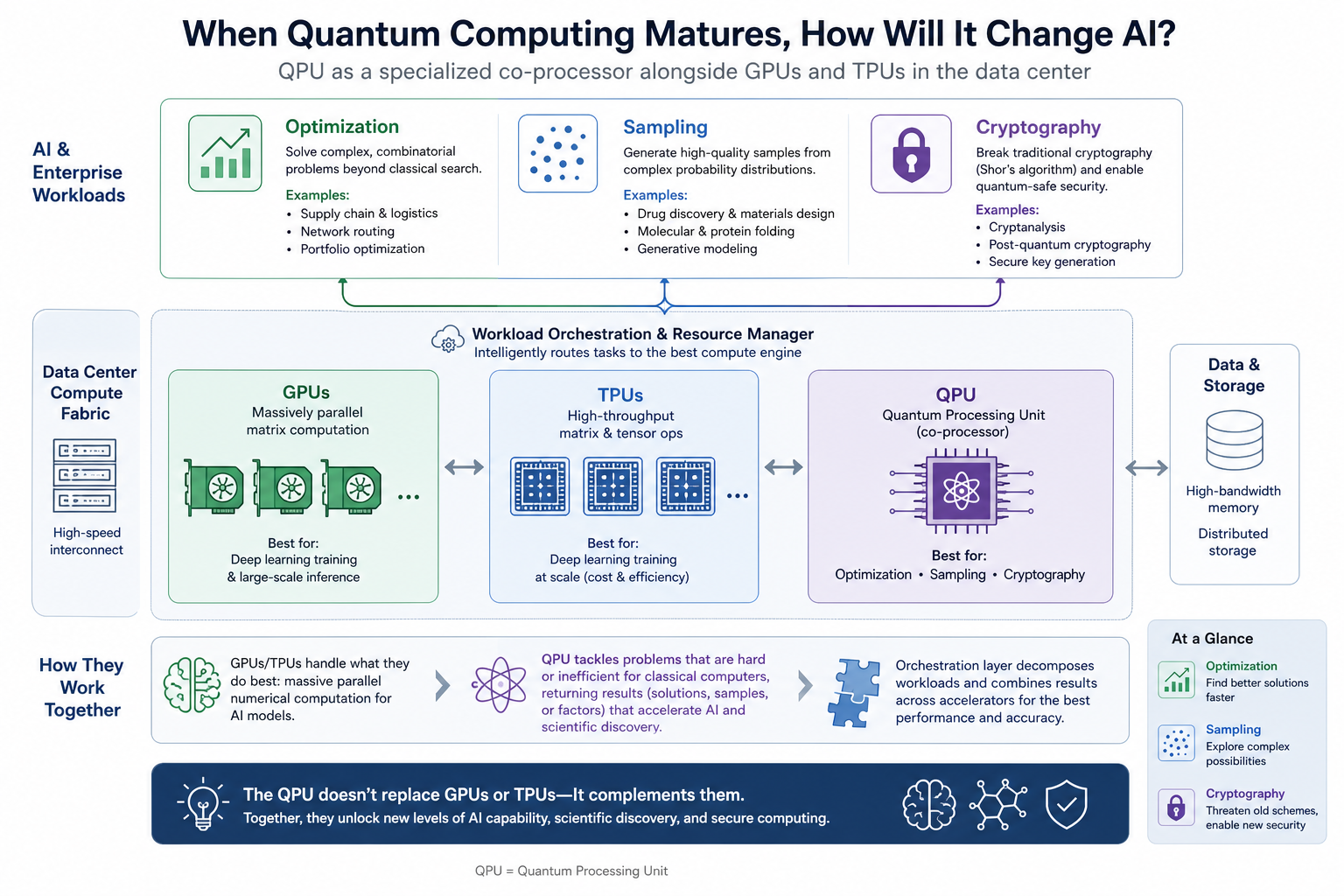
Two application areas come up most consistently:
Optimization. Many AI-adjacent problems—supply chain routing, financial modeling, protein folding—are fundamentally about searching a vast space of possible solutions for the best one. Quantum algorithms can, in principle, evaluate exponentially more possibilities simultaneously than classical algorithms, which is why optimization is consistently cited as one of the most promising near-term applications. For AI systems that rely on solving large-scale optimization problems—resource allocation in training infrastructure, hyperparameter search, or logistics-style reinforcement learning environments—a mature quantum accelerator could offer real speedups.
High-dimensional data modeling. Quantum systems are also being explored for their potential to enable more efficient analysis of complex, high-dimensional datasets, which is crucial for AI training. Classical computers can struggle with certain classes of high-dimensional statistical problems, and quantum approaches to sampling and probability estimation are an active area of research relevant to generative modeling and Bayesian methods used in AI systems.
What's notably absent from credible technical assessments is any claim that quantum computers will directly accelerate the core training or inference of large neural networks in the way GPUs do today. That distinction is important for architects evaluating where to place their long-term infrastructure bets.
The Hardware Roadmap: Where the Industry Broadly Agrees
Despite disagreements over ultimate impact, there's a surprising degree of convergence among major players on the timeline for a specific milestone: fault-tolerant quantum computing, meaning quantum systems that can perform sustained, reliable computations by correcting errors faster than they accumulate.
IBM has published the most detailed public roadmap in the industry. The company has developed a detailed framework for achieving large-scale fault-tolerant quantum computing by 2029, updating its roadmap to match that target. Specifically, by 2029, IBM plans to deliver a system called Quantum Starling—a large-scale, fault-tolerant quantum computer capable of running quantum circuits comprising 100 million quantum gates on 200 logical qubits. That's a meaningful jump from today's noisy, error-prone devices, but it's a specific engineering target rather than a vague promise.
McKinsey's survey data offers a broader industry sentiment check: 72% of tech executives, investors, and academics surveyed said a fully fault-tolerant quantum computer could arrive by 2035. That's a six-year spread from IBM's own target—useful context for anyone building a business case around a specific arrival date.
Google's Willow chip, unveiled in December 2024, generated significant attention for a benchmark result: Google reported that Willow reduces errors as more qubits are used (a long-sought property called below-threshold error correction) and can perform in five minutes a calculation that would take a classical computer an estimated 10 septillion years. It's worth being precise about what this demonstrates and what it doesn't: this was a contrived benchmark designed to showcase quantum advantage on a specific, narrow computational task—not a practical, real-world application relevant to AI or industry workflows.
McKinsey's 2026 monitor captures both the convergence and the uncertainty well: IBM has outlined a path to fault tolerance by the end of the decade, and companies like IonQ, IQM, and QuEra have published similarly ambitious timelines. However, there is a lack of visibility on the surety of these roadmaps, with projections spanning from hundreds to hundreds of thousands of logical qubits depending on the source. That's a wide enough range that technical leaders should treat any single date as a scenario, not a certainty.
The table below summarizes the major public timelines and benchmarks referenced above:
| Source | Milestone / Claim | Target Date |
|---|---|---|
| IBM | Quantum Starling: fault-tolerant system, 100M quantum gates, 200 logical qubits | 2029 |
| McKinsey survey | 72% of surveyed executives/investors/academics expect fault-tolerant quantum computing | By 2035 |
| Willow chip demonstrates below-threshold error correction; narrow benchmark task | Announced Dec. 2024 | |
| IonQ, IQM, QuEra | Similarly ambitious fault-tolerance roadmaps (varying qubit-count projections) | Range varies by source |
The Gap Between Announcements and Applied Reality
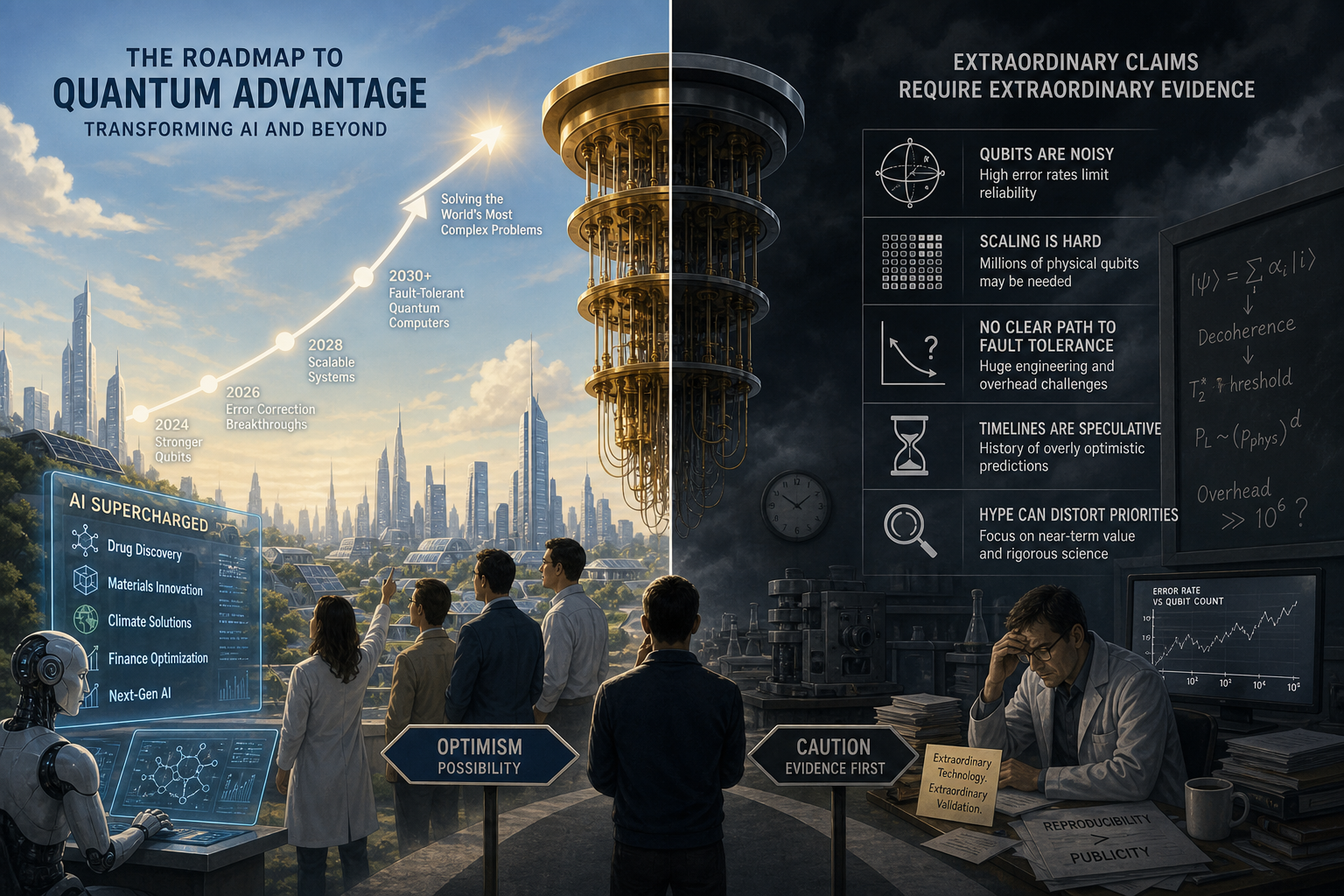
For every optimistic roadmap, there's a corresponding voice urging caution—and the gap between the two is instructive rather than merely rhetorical.
The scale problem is still enormous. Consider quantum's most famous theoretical application: breaking RSA-2048 encryption. Gidney and Ekerå's 2021 analysis, widely regarded as the authoritative published estimate, puts the physical qubit requirement at approximately 20 million. IBM's best deployed hardware, by contrast, sits at 120–156 physical qubits. That's a gap of several orders of magnitude, and closing it requires genuine breakthroughs in fault-tolerant quantum error correction—not simply adding more qubits to existing noisy architectures. The same scale challenge applies, in different proportions, to quantum applications relevant to AI.
Technical skeptics are pushing back directly on AI-specific claims. A widely-discussed technical paper from researchers at Microsoft, Amazon, and the Swiss National Supercomputing Centre argues that quantum computing will not necessarily advance AI, because quantum computers encounter real difficulties processing information from neural networks and the voluminous data those systems require. The core issue: quantum computers are very slow at getting data in and out, and can only perform very short calculations before errors accumulate. That same analysis noted a downward trend in tone at a 2024 quantum machine learning conference, with more experts recognizing that quantum computers will likely remain very slow when it comes to input and output of data—a fundamental bottleneck sometimes called the "I/O problem" in quantum machine learning.
Prominent individual voices have been similarly blunt. Computer scientist Scott Aaronson of UT Austin, one of the field's most respected theorists, has said plainly that claims about how quantum computing will revolutionize machine learning, optimization, finance, and other industries deserve the skepticism they've long received. Notably, this caution isn't coming only from outside the industry. Oskar Painter, AWS's own head of quantum hardware, has acknowledged there is a "tremendous amount of hype" in the industry, adding that it can be difficult to filter the optimistic from the completely unrealistic.
Meta's chief AI scientist Yann LeCun has also expressed skepticism, though it's worth noting he approaches the topic from an AI background rather than quantum physics expertise specifically. LeCun called quantum computing "a fascinating scientific topic" but said he was less convinced about the possibility of actually fabricating quantum computers that are actually useful at scale. Mathematician Gil Kalai has gone further still, arguing that the fragile, rapidly-decohering nature of quantum states, combined with theoretical complexity barriers, could mean quantum computers may never reliably perform the complex operations needed for genuinely large-scale computations—a more fundamental objection than a simple timeline disagreement.
What This Means for Technical Decision-Makers
Pulling these threads together, a few practical conclusions emerge for architects and technical leaders evaluating where quantum computing fits into AI strategy.
On timing, most credible estimates for genuinely fault-tolerant, large-scale quantum computing cluster around 2029 to 2035—not now, and not within the next product cycle. Even the most detailed and optimistic industry roadmap, IBM's 2029 target, remains unproven. McKinsey itself cautions that the near- to medium-term return on investment for quantum computing remains difficult to quantify, with most applications still in experimental or hybrid phases. Any procurement or R&D decision built around near-term quantum-AI advantage should be treated as exploratory, not foundational.
On the nature of the eventual impact, the expected pattern is augmentation rather than replacement. Quantum hardware, when mature, is expected to accelerate specific tasks—optimization, sampling, and materials or drug simulation workflows that feed into larger AI pipelines—while classical GPUs and TPUs continue to handle the core work of deep learning training and inference. Organizations planning AI infrastructure over the next decade should think in terms of heterogeneous compute environments that may eventually include quantum co-processors for narrow tasks, not a future where quantum chips replace today's accelerator stack.
On the disagreement itself, it's genuine and worth taking seriously rather than dismissing as normal hype-cycle noise. On one side sits roadmap optimism from IBM, Google, McKinsey's surveyed executives, and companies like Quandela. On the other sits a vocal and technically credible contingent of computer scientists and physicists—including voices from within Amazon and AWS itself—who argue that quantum's practical contribution to mainstream AI and machine learning may be considerably smaller, or slower to materialize, than marketing narratives suggest. Some observers explicitly warn of the risk of a "quantum winter"—a period of disillusionment and reduced investment—if hype continues to outpace delivered, practical results.
For technology professionals building multi-year strategies, the sensible posture is neither dismissal nor uncritical enthusiasm. It means tracking the concrete milestones—IBM's Quantum Starling target, error-correction benchmarks like Google's Willow, and the qubit-count gap relative to real-world problems—while treating quantum-AI convergence as a longer-term, narrower, and more hybrid story than the most enthusiastic headlines imply. The technology is real, the research investment is substantial, and the trajectory is toward genuine capability. But for now, the most accurate statement about quantum computing's effect on AI is that it hasn't happened yet—and won't, in any substantial way, for several more years at minimum.