Few sectors in technology generate as much simultaneous excitement and confusion as robotics did through 2025 and into 2026. Depending on which analyst report you read, the humanoid robot market is worth anywhere from $2.4 billion to nearly $8 billion today, growing at rates between 28% and 50% annually. Depending on which venture capital tracker you consult, robotics and "physical AI" startups raised somewhere between $18.6 billion and $55.8 billion in the first half of the year alone. And depending on whether you ask a Wall Street analyst or a veteran roboticist, Tesla's Optimus program is either months away from transforming manufacturing or an exercise in "pure fantasy thinking."
For technology professionals and decision-makers trying to evaluate where to place bets—whether in R&D, procurement, or investment—this divergence matters as much as the headline numbers. This article walks through what's verifiably happening in industrial robotics, why humanoid forecasts vary so wildly, what Tesla's own disclosures reveal about the gap between roadmap and reality, and what the capital markets are telling us about where the industry believes this is heading.
The Industrial Baseline: A Market Already at Scale
Before diving into humanoids, it's worth grounding the conversation in industrial robotics, which is not a speculative category—it's an established, measurable market. According to the International Federation of Robotics (IFR), the global market value of industrial robot installations has reached an all-time high of $16.7 billion. This is the traditional backbone of automation: robotic arms, palletizers, welding cells, and other single-purpose machines that have been deployed in factories for decades.
What's changing in 2026 isn't the existence of this market but its underlying software layer. The IFR identifies AI-driven autonomy as a defining trend: robots increasingly use analytical AI to process large operational datasets, detect patterns, and generate actionable insights. In practice, this means a robot on a smart factory floor can anticipate mechanical failures before they occur, or a logistics robot can dynamically replan its path around obstacles rather than following a fixed route. This is an incremental but meaningful shift—it turns robots from purely reactive machines into systems that optimize their own behavior over time.
Agentic AI: Combining Structure with Adaptability
A more architecturally significant trend the IFR highlights is agentic AI in robotics. This refers to systems that combine analytical AI—suited to structured, rules-based decision-making—with generative AI, which brings adaptability to novel or ambiguous situations. The goal is robots that can operate independently in complex, real-world environments rather than requiring engineers to explicitly program every contingency in advance.
For architects and technical decision-makers, this convergence is the practical takeaway: the interesting engineering problem in 2026 isn't building better actuators or motors, it's building the decision-making stack that sits on top of them. That stack increasingly resembles the agent architectures being deployed in enterprise software—perception, planning, and action loops—just applied to physical rather than digital environments.
Physical AI: From Prototype to Pilot
Industry analysts describe 2026 as the year physical AI moved from prototypes into production pilots. The distinction being drawn is important: traditional industrial robots are programmed for a single repetitive task within a tightly controlled environment. Physical AI agents—often, though not necessarily, humanoid in form—are designed to perceive, understand, and navigate unstructured environments, a capability driven largely by advances in Vision Language Models (VLMs).
This is the same underlying technology trend reshaping enterprise software—large multimodal models capable of interpreting visual and linguistic context—being redirected toward physical embodiment. Rather than a robot arm executing a fixed motion sequence, a physical AI system can, in principle, interpret an unfamiliar scene, reason about the objects and obstacles within it, and generate an appropriate action plan on the fly.
Why Humanoids Specifically
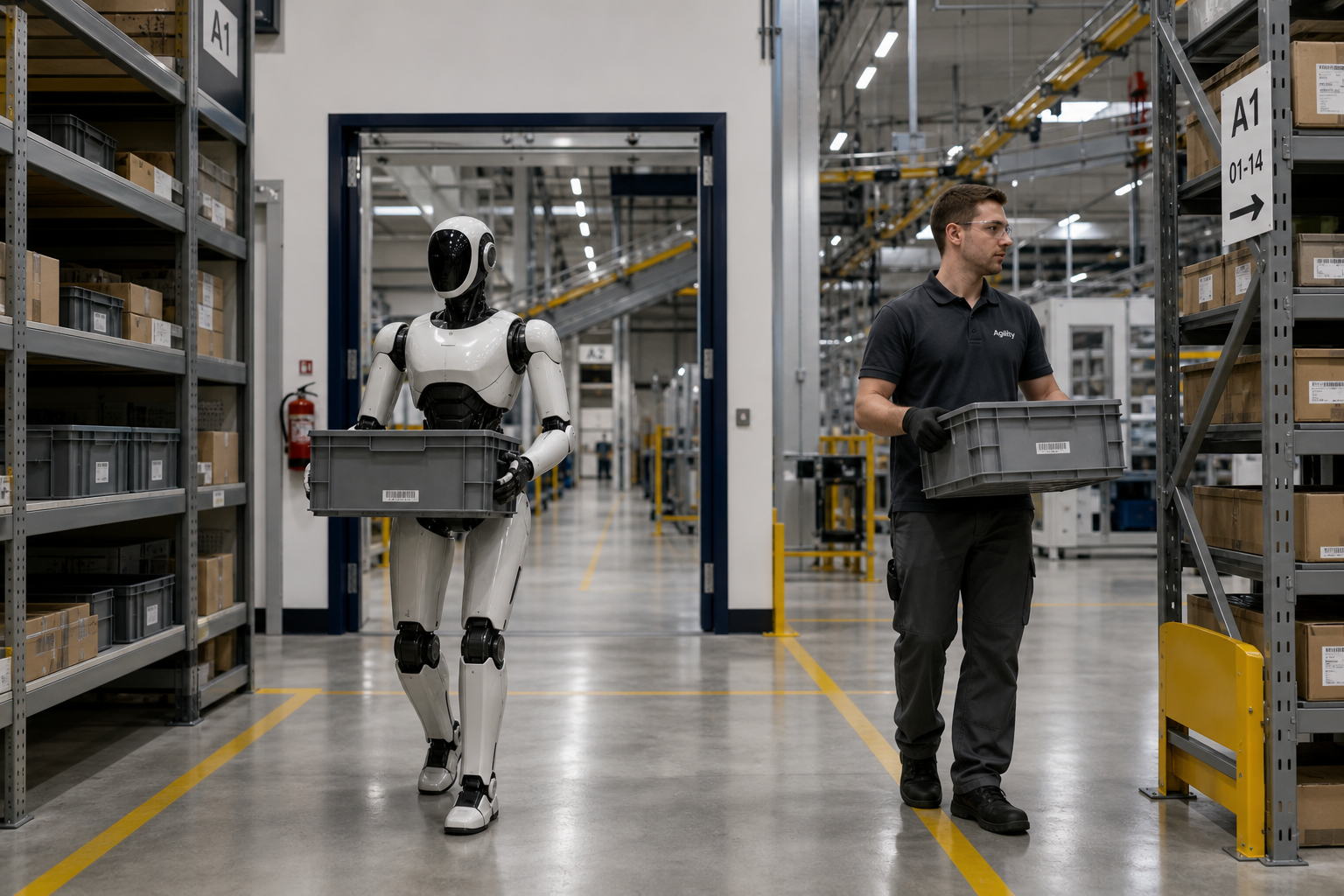
The IFR notes that humanoid robotics is expanding rapidly, with the form factor seen as particularly promising in human-designed environments—warehouses, factories, and eventually other settings built around human dimensions and workflows. The reasoning is straightforward from an infrastructure standpoint: environments built for humans (with human-scale doorways, tools, shelving, and controls) don't need to be re-engineered if the robot working in them is human-shaped and human-scaled. This is why the automotive industry, which pioneered much of the current wave of humanoid deployment interest, remains a bellwether use case, with warehousing and manufacturing applications now coming into focus globally.
It's worth being precise about what "coming into focus" means at this stage: pilots and early deployments, not mass-scale production replacing human labor. That distinction becomes especially clear when examining the industry's most closely watched humanoid program.
Divergent Market Forecasts: Why the Numbers Don't Agree
Anyone evaluating the humanoid robotics opportunity needs to reconcile a genuinely confusing spread of market-sizing estimates from reputable research firms:
| Research Firm | 2025 Estimate | 2026 Estimate | Long-Term Projection | CAGR |
|---|---|---|---|---|
| GMI Insights | $7.9 billion | $10.9 billion | $192.7 billion by 2035 | 37.6% |
| MarketsandMarkets | — | $5.41 billion | $50.27 billion by 2035 | 28.1% |
| Fortune Business Insights | $4.89 billion | $6.24 billion | $165.13 billion by 2034 | 50.60% |
| Grand View Research | $2.4 billion | $4.2 billion | 900,000+ units by 2033 (from 15,000 in 2025) | — |
The spread between these figures—more than 3x variance even for the same year—almost certainly reflects differing scope definitions rather than genuine analytical disagreement about the underlying trend. Some firms may be counting only fully autonomous, commercially shipped humanoid units; others may include prototype and pilot deployments, robotic components sold into humanoid platforms, or adjacent categories like teleoperated systems. For technical decision-makers, the practical lesson is not to anchor on any single absolute figure but to note the shared directional signal: every major research firm projects sustained, high double-digit CAGR growth through the next decade, and several converge on unit shipments crossing into the hundreds of thousands by the early-to-mid 2030s.
On geography, there's similarly rough but not universal consensus: several sources point to Asia Pacific as either the current largest or fastest-growing regional market, with some estimates projecting the region will account for more than 50% of global market share throughout the forecast period, while other data sources show North America currently in the lead. Given the concentration of both manufacturing capacity and robotics supply chains in East Asia, a long-term shift toward APAC dominance is a reasonable expectation, even if the timeline for that shift is contested.
Tesla Optimus: A Case Study in Roadmap Versus Reality
No single program better illustrates the gap between humanoid robotics hype and hardware reality than Tesla's Optimus. As of the company's Q2 2026 earnings disclosure, formal Optimus production on Tesla's new Fremont line had not started. Tesla's own language was notably hedged, offering only an outlook "in anticipation of production in 2026" rather than confirmed manufacturing output. The company confirmed it was installing the first-generation production lines for Optimus, with actual unit output still effectively zero. Notably, even the first units to come off that line are slated for training-data collection rather than any productive factory task—meaning the earliest Optimus units will be used to generate the sensor and movement data needed to train future versions, not to perform useful work.
The Specifications Gap
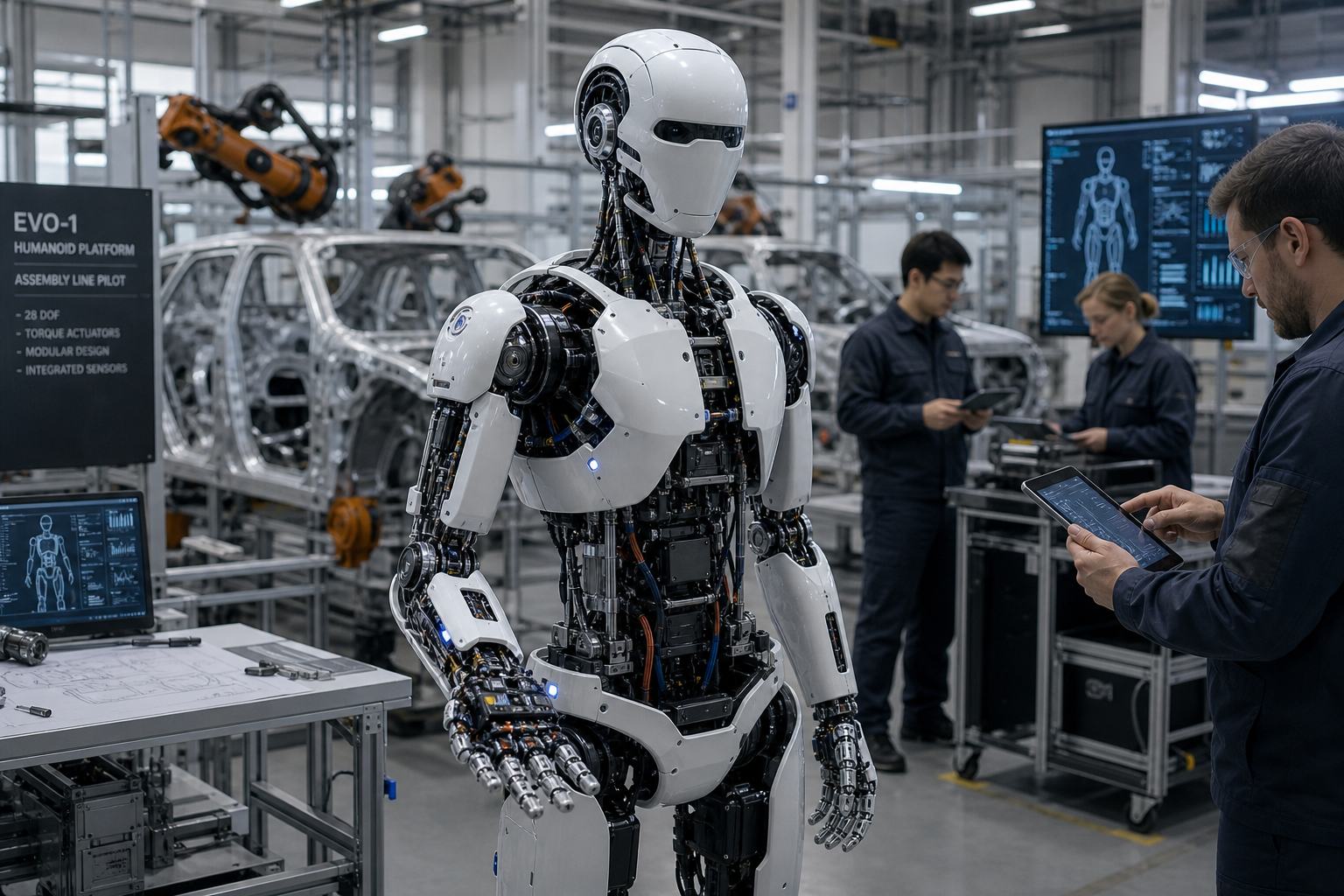
The published specifications for Optimus V3 are genuinely impressive on paper: the robot measures 173 cm (5'8") and weighs 57 kg, with hands featuring 22 degrees of freedom driven by 50 actuators, and it runs on Tesla's new AI5 chip. Tesla's long-term price target is $20,000–$30,000 per unit—a figure clearly aimed at the kind of mass-market deployment that would make humanoid labor economically comparable to human wages in various industrial contexts.
But current build costs are reported far higher, in the range of $50,000 to $100,000-plus per unit. That's a 2-5x gap between where the technology needs to land on cost and where it currently sits—a gap that has to close through manufacturing scale, supply chain maturation, and component cost reduction, none of which happen instantly even with substantial capital behind them.
The Financial Stakes
The financial commitment behind this bet is substantial. Wall Street projects negative free cash flow of $5.19 billion for Tesla in 2026 as the company invests toward Optimus—a figure that puts real financial weight behind the program regardless of near-term production numbers. For context on how ambitious Tesla's stated targets are, Deutsche Bank estimated the entire humanoid robot market could reach 200,000 annual unit sales by 2035. Tesla's own internal target is to reach that same 200,000-unit figure in 2026 alone—a single year, a decade ahead of what one major bank sees as a reasonable market-wide ceiling.
This is precisely the kind of gap that has prompted skepticism from veteran roboticists. Rodney Brooks, a widely respected figure in the field, has called the vision of humanoid robots as general-purpose catchall assistants "pure fantasy thinking" as of 2025. For technical decision-makers, Brooks's skepticism is a useful counterweight to vendor roadmaps: it's the perspective of someone who has spent decades building robots and understands how far actual deployed capability tends to lag announced capability, particularly around perception robustness, manipulation dexterity, and safety certification in unstructured environments.
Historically, ambitious Tesla technology timelines—full self-driving being the most cited example—have tended to slip by years rather than months. Whether Optimus follows that same pattern, or whether the underlying AI advances (particularly in vision-language models) allow humanoid robotics to compress its development timeline relative to autonomous driving, remains an open and consequential question for anyone planning around this technology.
Capital Flows: Consistent Direction, Inconsistent Totals
If market-sizing forecasts are inconsistent, investment tracking data is, if anything, even more so—though again, the directional signal is unambiguous. Three major trackers report substantially different totals for 2026 robotics investment:
| Tracker | Reported Figure | Scope/Notes |
|---|---|---|
| PitchBook | $18.6 billion (Q2 2026 alone) | 450 deals; deal value up 25.3% quarter-over-quarter |
| Crunchbase | $47.4 billion (H1 2026) | 521 deals; broader "physical AI" definition including aerospace and drones; up from $12 billion in H2 2025 |
| Dealroom (via CNBC) | $55.8 billion (2026 to date) | Record, nearly double the prior year's record |
As with the market-sizing discrepancies, these gaps almost certainly stem from differing category definitions—narrow "robotics" versus broader "physical AI" that sweeps in aerospace, drones, and adjacent categories. What's consistent across all three trackers is the trajectory: 2026 investment figures represent records, often by wide margins over the prior year, regardless of which methodology is applied.
Specific deals illustrate where capital is concentrating. Germany's Neura Robotics secured up to $1.4 billion in Series C funding led by Tether. Skild AI raised $1.4 billion, tripling its valuation to over $14 billion—notable because Skild is a foundation-model company for robotics rather than a hardware manufacturer, suggesting investors see as much value in the software/perception layer as in the physical platforms themselves. Defense-tech firm Saronic raised $1.75 billion in a Series D round at a $9.25 billion valuation, reflecting how physical AI investment is spilling into adjacent categories like autonomous maritime and defense systems.
Underscoring the scale of ambition driving this capital, Nvidia CEO Jensen Huang has publicly called humanoids a "multitrillion-dollar economic opportunity"—a framing that, whether or not it proves accurate, has clearly helped catalyze investor conviction across the sector.
What This Means for Technical Decision-Makers
Pulling these threads together, a few conclusions are well-supported by the available data.
First, industrial robotics augmented with analytical and agentic AI is not speculative—it's a $16.7 billion market already deploying AI-driven predictive maintenance and autonomous path planning in production environments today. Organizations evaluating automation investments can treat this layer as mature enough for near-term deployment planning.
Second, humanoid robotics specifically remains in an early, volatile, pilot-stage market, regardless of which market-sizing report you trust. The wide variance in forecasts—from $2.4 billion to $7.9 billion for essentially the same 2025 baseline—should be read as a signal of definitional immaturity in the category itself, not necessarily analytical incompetence. Decision-makers should treat any single-source humanoid market forecast with appropriate skepticism and focus instead on the shared directional consensus: sustained high growth, with meaningful unit-volume scale likely still several years out.
Third, Tesla's Optimus program—as the most closely watched and best-documented humanoid effort—offers a useful calibration point for the entire sector's timeline risk. A company with Tesla's manufacturing expertise, capital access, and vertical integration still had not started formal production as of Q2 2026, with its own most advanced current units earmarked for data collection rather than productive work. If Optimus, specifically, faces a multi-year gap between roadmap and shipped capability, comparable or greater delays across less-resourced competitors should be considered the base case rather than the exception.
Finally, the record capital flows into the sector—however you total them—indicate that the investment community is pricing in a multi-year, not multi-quarter, path to return. That's consistent with historical patterns in capital-intensive hardware categories, and it suggests the current moment is best understood as an infrastructure and R&D buildout phase rather than an imminent inflection point in deployed capability. For technology professionals tracking this space, the prudent posture is active monitoring and selective pilot engagement, rather than assuming near-term, large-scale humanoid deployment is imminent across industrial or commercial settings.